 How-to
Is Seasonal Tree Trimming Worth It in 2026?
Last Updated: November 4, 2026
Quick Summary
Seasonal tree trimming is worth it for most homeowners when cuts are timed to each tree's growth cycle. Pruning during the dormant season generally helps trees heal faster and resist disease, while poorly timed cuts can add stress. The best window depends on the species, the cut needed and local climate.
- Dormant-season pruning suits most deciduous trees because they recover quickly from cuts then.
- Prune spring-flowering trees right after they bloom to keep that year's flowers.
- Avoid pruning oaks during warm months where oak wilt is a concern.
- Many mature trees do well with light pruning every one to three years.
- Keep heavy cuts and near-power-line work with a professional arborist.
Table of Contents
- Why Seasonal Tree Trimming Matters for Tree Health
- Best Time to Trim Trees by Season
- Tree Pruning by Season: A Step-by-Step Calendar for 2026
- Reducing Safety Risks and Protecting Property Through Timely Cuts
- How Often to Trim Trees for Lasting Results
- Using Trimming to Prevent Storm Damage
- Booking Your 2026 Tree Trimming Visit With Roadrunner Yard Maintenance
- Frequently Asked Questions
Is seasonal tree trimming worth it in 2026? For most homeowners in Albuquerque, the answer is yes, but only when the cuts are timed to the tree. Well-timed pruning generally keeps trees healthier and safer, while poorly timed cuts can invite stress and disease.
Seasonal tree trimming is simply pruning on a schedule that matches a tree's growth cycle. The right season depends on the species, the cut you need and the job you are doing.
Why Seasonal Tree Trimming Matters for Tree Health
Pruning removes the wood a tree no longer needs, and timing decides how well it recovers. Cuts made at the right point in the growth cycle close faster and give the tree less to fight off.
Here is what good seasonal pruning does for tree health:
- Removes dead, damaged, or diseased branches before they spread decay
- Improves airflow and sunlight through the canopy
- Strengthens branch structure so limbs hold up in wind and snow
A common mistake is trimming everything at once. Pruning should be selective. Selective pruning generally takes more time but follows the plant's natural shape.
Best Time to Trim Trees by Season
For most deciduous trees, the best window is the dormant season. Trees are not actively growing, so they recover quickly from cuts.
Each season has its own trade-offs:
- Late fall to early spring (dormant season): Best for most deciduous trees. Cuts heal well and disease pressure is lower.
- Early fall: Can help in spotting problem areas, since stressed foliage makes them easier to see.
- Late spring and summer: Best for light corrections and deadwood removal. Avoid heavy cuts during active growth.
Pruning can happen outside a single seasonal window, since light pruning and dead-wood removal can generally be done at any time of year.
Dormant-Season Pruning for Deciduous Trees
Dormant-season pruning is a common choice for many shade trees, and most deciduous trees are often pruned from late fall, after dormancy begins, through very early spring.
Why does dormancy matter? A dormant tree has no active sap flow and no fresh leaves to feed.
Watch out: pruning a flowering tree in the wrong season can remove next year's blooms. Check the species before you cut.
Which Trees Should Not Be Pruned in Each Season
Not every tree follows the dormant-season rule. Some species bleed sap heavily when cut in late winter, and others are prone to disease when pruned during wet or warm months.
- Spring-flowering trees: Prune right after they bloom, not in winter.
- Oaks: Avoid pruning during warm months to reduce the risk of oak wilt spread.
- Evergreens: Light shaping is best in early spring or after new growth hardens.
These are general guidelines. Local climate, tree age and health all change the answer, so check the species before scheduling work.
Tree Pruning by Season: A Step-by-Step Calendar for 2026
A calendar is only useful if it accounts for the tree in front of you and the weather in your area. The table below is a starting framework for 2026, not a universal rule. Adjust each window using your USDA hardiness zone, your average last-frost and first-frost dates, and the species notes that follow.
| Season | Typical window | Best for | Avoid |
|---|---|---|---|
| Late dormant (late winter) | After the coldest weather has passed, before bud break | Structural pruning on most deciduous shade trees; removing dead, crossing, and rubbing limbs | Spring-flowering trees; species that bleed heavily (maples, birches, walnuts) if you want a clean look |
| Early spring | Just before and as new growth begins | Evergreen shaping; removing winter damage; light cleanup | Heavy cuts during active sap flow on bleeders |
| Late spring to early summer | After spring-flowering trees finish blooming | Pruning spring bloomers; light deadwood removal | Oaks in areas with oak wilt pressure; major structural cuts in heat |
| Summer | During active growth | Removing dead, damaged, or hazardous limbs; light corrective cuts | Heavy thinning that exposes bark to sunscald |
| Early fall | After growth slows, before hard freeze | Inspection; identifying problem limbs; light deadwood removal | Heavy cuts that leave wounds open going into winter |
| Late fall to early winter | After leaf drop, before deep cold | Dormant structural work on tolerant species | Fresh cuts on cold-sensitive or recently planted trees |
Species-specific timing notes for 2026
- Oaks: In areas with oak wilt pressure, the safe window is the dormant season; avoid pruning from roughly April through July when the beetle vectors are active. Check with your state extension office for local guidance.
- Maples, birches, and walnuts: These bleed heavily when pruned in late winter or early spring. If a clean appearance matters, prune in late spring or early summer after leaves have fully expanded.
- Spring-flowering trees (dogwood, crabapple, lilac, forsythia): Prune right after bloom. Pruning in winter or early spring removes the flower buds for that year.
How local climate shifts the window
Frost dates, heat, and drought change the ideal timing more than the calendar month does. In colder zones, dormant pruning can start earlier and run longer; in warmer zones, the dormant window is shorter and summer heat stress is a bigger risk. In a drought year, avoid heavy pruning that forces new growth the tree cannot support. After a late frost, delay structural cuts until you can see which wood is actually dead.
Step-by-step for each pruning visit
- Inspect first. Look for dead, rubbing, crossing, or broken branches, and note the species and its bloom timing.
- Plan the cuts. Target the wood you need to remove, not the whole canopy. Decide whether this is a structural, clearance, or cleanup visit.
- Make clean cuts just outside the branch collar, with the final cut on the branch side of the collar rather than flush to the trunk.
- Use the three-cut method on heavy limbs to prevent bark tearing: an undercut, a top cut farther out, and a final cut at the collar.
- Remove deadwood before any live pruning, and sanitize tools between trees if disease is a concern.
- Check the result and note what to watch next season.
Watch out: pruning a spring-flowering tree in winter removes the buds that would have bloomed that year, and pruning oaks in warm months raises the risk of oak wilt spread in areas where it is present.
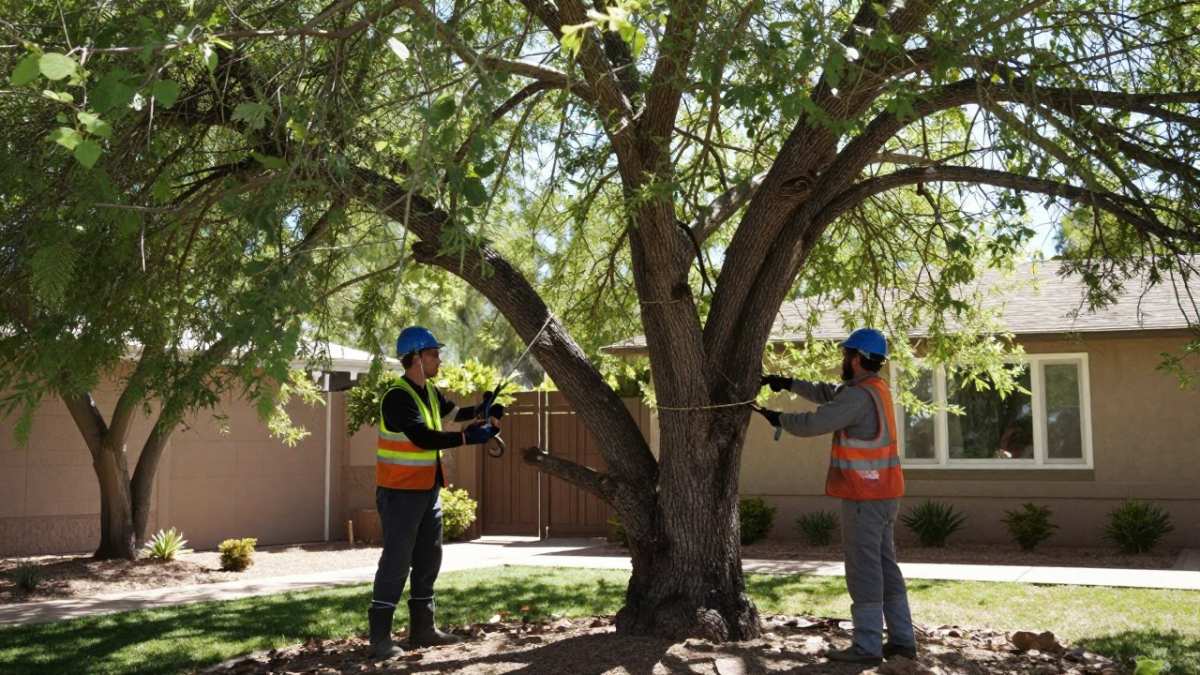
!A landscape crew member in protective gear pruning the lower branches of a mature shade tree in a sunny Albuquerque backyard
Reducing Safety Risks and Protecting Property Through Timely Cuts
Dead or weakly attached branches can be a hazard, and timely pruning can remove them before a storm. The safety benefit depends on making the cuts correctly and keeping the job within what a homeowner can safely handle.
Cut placement and technique that protects the tree
A clean cut heals; a bad cut invites decay. The branch collar, the swollen area where the branch meets the trunk, is the tree's natural barrier zone. Make the final cut just outside the collar, angled so the wound drains, rather than flush to the trunk. On limbs too heavy to hold, use the three-cut method: an undercut a foot or so out from the trunk, a top cut slightly farther out to remove the weight, and a final cut at the collar.
Tool guidance and DIY limits
- Hand pruners for small twigs and branches up to about half an inch.
- Loppers for branches up to roughly one and a half to two inches.
- Pruning saw for limbs up to several inches; use a pole saw for higher small cuts.
- Chainsaws for larger limbs, only if you are trained and wearing protective gear.
A practical rule most practitioners use: if a cut requires a chainsaw, a ladder, or working above shoulder height near a structure, it is past the DIY line. Leave structural pruning, large removals, and anything near power lines to a professional.
Protecting roofs, gutters, and nearby property
Keep branches clear of roofs, gutters, and power lines. Trimming back limbs that overhang the house reduces the chance of damage during a windstorm, and clearing gutters of debris after pruning prevents water backup. Watch for limbs that rub against siding or roofing, since repeated contact wears both the tree and the structure.
When to hire an arborist
Call a professional when you see cracks, splits, leaning trees, large dead limbs over a structure, or any work near power lines. A certified arborist can assess risk and recommend removal, cabling, or structural pruning. Pricing depends on the size of the job, the number of trees, and access on site. For current pricing or a custom quote, contact Roadrunner Yard Maintenance.
How Often to Trim Trees for Lasting Results
Many mature trees can do well with light pruning every one to three years, though young trees often need more frequent shaping. Trees with a history of storm damage or disease may need more regular attention.
A regular schedule works better than heavy cuts every few years. Small, steady pruning keeps the canopy balanced and avoids big wounds.
Using Trimming to Prevent Storm Damage
Storm damage often starts with weak wood that was never addressed. Pruning in the dormant season lets you remove weak forks, crossing limbs and deadwood before wind season.
Before a storm season, have a professional inspect large trees. Cutting back heavy limbs, especially over structures, lowers the risk of a costly failure. If you see cracks, splits or leaning trees, call for an assessment right away.
Booking Your 2026 Tree Trimming Visit With Roadrunner Yard Maintenance
Ready to plan your trimming? Roadrunner Yard Maintenance serves residential and commercial properties in Albuquerque. Explore our full range of yard care services to see what we offer, from tree trimming to irrigation maintenance.
To get started, contact our team and request a visit. Pricing depends on the size of the job, the number of trees and the access on site.
Frequently Asked Questions
What month is it best to trim trees?
For most deciduous trees, late fall after leaf drop through very early spring, before buds swell, is the preferred window. Many deciduous trees are commonly pruned from late fall after dormancy through very early spring, before buds swell. Fall can also be a useful time to prune because problem areas are easier to identify once stressed foliage shows them. Spring and summer work is still useful for light pruning and dead-wood removal, which can generally be done at any time of year. Species differences matter, so check the specific tree before scheduling.
Is it good to trim trees in the winter?
Winter, during full dormancy, is a common and often preferred time for structural pruning of deciduous trees because the plant is not actively growing and the branch structure is fully visible. Dormant-season pruning is commonly used for most deciduous trees. Avoid heavy cutting during deep freezes, and avoid pruning trees that bleed sap heavily in late winter, such as maples and birches, until the sap flow slows. Evergreens are generally pruned differently and should be handled based on species.
What are the benefits of pruning trees during the dormant season?
Dormant-season pruning lets an arborist see the full branch structure, make selective cuts that follow the tree's natural shape, and reduce stress because the tree is not actively growing. Selective pruning generally takes more time but follows the tree's natural shape. Cuts made while the tree is dormant also give it a clean start when growth resumes in spring, which supports faster wound closure and better vigor.
How often should you trim your trees?
Most mature trees benefit from a light inspection and pruning every one to three years, with more frequent attention for young trees that are still establishing structure. Dead, damaged, or diseased branches can be removed whenever they are found, since light pruning and dead-wood removal can generally happen at any time. A professional assessment helps set the right interval for each tree based on species, age, and site conditions.
Seasonal tree trimming is worth it when the timing fits the tree. Dormant-season pruning, careful inspection and regular light maintenance protect your trees and your property. Let us help you build a schedule that works for your yard in 2026.